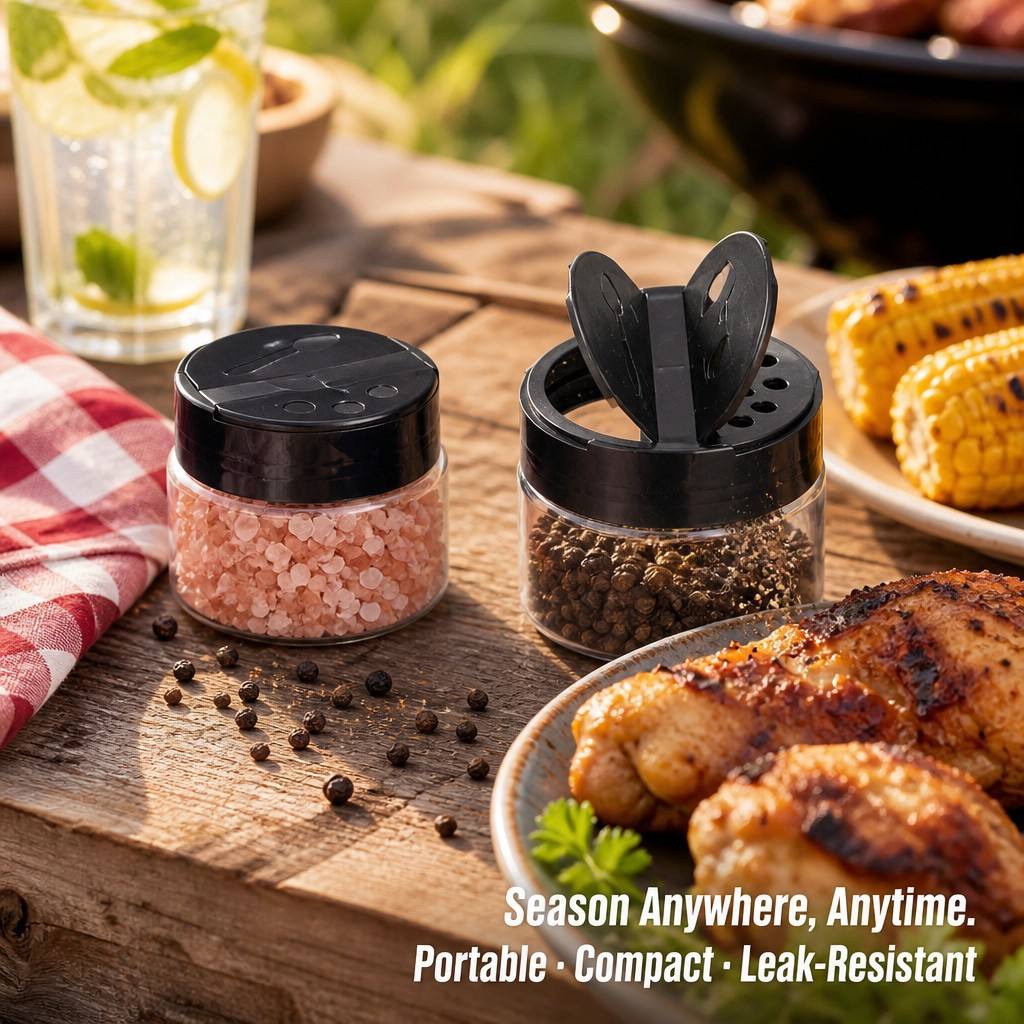
Mini plastic spice jars are widely used in the food packaging industry for storing and distributing salt, pepper, chili powder, garlic powder, herbs, and other dry seasonings. Their compact size, lightweight construction, and flexible lid designs make them suitable for retail packaging, household use, and foodservice applications.
However, sourcing plastic spice jars involves more than comparing product prices and appearance. Buyers need to evaluate material safety, container capacity, lid structure, sealing performance, manufacturing consistency, and supplier capabilities before placing bulk orders.
From a manufacturer's perspective, these factors directly affect the usability of the finished packaging, production efficiency, and the overall purchasing cost. Below are several important points that importers, wholesalers, and seasoning brands should consider when sourcing mini plastic spice jars.
1. Check the Plastic Material and Food Contact Compliance
Material selection is one of the first things buyers should investigate. Since spice jars come into direct contact with food, the plastic material must meet the food contact requirements of the target market.
Common plastics used in food packaging include polypropylene (PP), polyethylene terephthalate (PET), and high-density polyethylene (HDPE). Each material has different characteristics in terms of transparency, rigidity, chemical resistance, and processing performance.
For example:
- PP: Offers good chemical resistance and is commonly used for food containers and closures.
- PET: Provides good transparency and rigidity, making it suitable for packaging where product visibility is important.
- HDPE: Has good impact resistance and chemical resistance, although it is generally less transparent than PET.
The appropriate material depends on the jar structure, intended seasoning, storage conditions, and packaging requirements.
Food contact compliance is another important consideration. In the European Union, Regulation (EU) No. 10/2011 establishes requirements for plastic materials intended to come into contact with food. Its overall migration limit is 10 mg/dm² of food contact surface, alongside specific migration limits for certain substances.
In the United States, food contact substances must have an applicable authorization or regulatory basis for their intended conditions of use under FDA requirements.
Buyers should therefore ask manufacturers for relevant material declarations, food contact documentation, and migration test reports where applicable. A general statement that a product is made from food-grade plastic is not a substitute for supporting compliance documents.
2. Choose the Right Capacity for Your Seasoning Products
Container capacity directly affects packaging costs, product positioning, and consumer convenience.
A small spice jar may be suitable for premium seasonings, sample-size products, specialty herbs, or individual seasoning portions. Larger containers may be more appropriate for frequently used household spices or foodservice applications.
When selecting capacity, buyers should consider more than the nominal volume.
The density of different seasonings can vary considerably. For instance, the same 130 ml container may hold different weights of salt, ground pepper, dried herbs, or chili powder.
This means that volume and filling weight should be evaluated separately.
Manufacturers can help buyers determine the appropriate container size by considering:
- Bulk density of the seasoning.
- Expected net weight per package.
- Particle size and filling characteristics.
- Available shelf space and retail packaging requirements.
- Consumer usage frequency.
For commercial orders, it is advisable to conduct filling trials with the actual seasoning before confirming the final packaging specification.
3. Evaluate the Lid Structure and Dispensing Design
The lid is one of the most important functional components of a plastic spice jar. It affects how consumers access the seasoning and how easily the product can be used during cooking.
Different lid structures serve different purposes. Common options include screw caps, shaker lids, flip-top lids, and dual-opening lids.
For jars with dual flip lids, buyers should pay attention to the following details:
- Opening Design: The lid should provide suitable dispensing openings for the intended seasoning. Fine powders and coarse particles may require different opening sizes.
- Opening and Closing Performance: The lid should open smoothly without excessive force. At the same time, it should remain securely closed during normal handling and transportation.
- Hinge Durability: Repeated opening and closing can place stress on the hinge area. Buyers should evaluate the hinge structure and conduct repeated-use tests.
- Fit Between Lid and Container: The lid should fit consistently with the jar opening. Poor dimensional matching may lead to loose closures, difficult assembly, or product leakage.
For manufacturers, these details are closely related to mold accuracy, injection molding conditions, and assembly quality.
A practical approach is to test samples with the actual seasoning before approving a large production order.
4. Pay Attention to Sealing Performance and Moisture Protection
Seasonings such as salt, garlic powder, onion powder, and ground spices can be affected by moisture during storage.
When moisture enters a container, certain powders may absorb water and form lumps, making them difficult to dispense. This is particularly important for products that are stored for extended periods or distributed through multiple transportation channels.
Buyers should understand that a flip-top lid does not automatically provide an airtight seal.
The actual sealing performance depends on the lid design, contact surfaces, fitting tolerances, and whether additional sealing components are used.
When evaluating samples, consider the following tests:
- Check whether the lid closes evenly.
- Inspect the contact area between the lid and container.
- Conduct inversion tests with the intended filling material.
- Evaluate the closure after repeated opening and closing.
- Consider additional sealing solutions if moisture sensitivity is a major concern.
For products requiring stronger moisture protection, manufacturers can assess whether an additional liner, induction seal, or other sealing structure is appropriate.
The final packaging solution should be selected according to the seasoning's storage requirements rather than relying on the lid design alone.
5. Inspect Injection Molding Quality and Dimensional Consistency
Injection molding is a major manufacturing process for plastic spice jars. The quality of the finished container depends on mold design, raw material consistency, processing conditions, and equipment maintenance.
Even small dimensional variations can affect the assembly between the jar and its lid.
For example, if the opening diameter varies between production batches, the lid may become too loose or require excessive force during assembly.
Buyers should pay attention to several common quality indicators:
- Wall thickness consistency.
- Container opening dimensions.
- Surface finish and transparency.
- Flash, deformation, and visible molding defects.
- Lid alignment and hinge structure.
- Overall dimensional stability.
For quality inspection, manufacturers can use measuring instruments such as digital calipers and thickness gauges to verify important dimensions.
A useful approach is to establish critical dimensions and acceptable tolerances before mass production. The inspection criteria should be agreed upon between the buyer and manufacturer.
For bulk orders, first-article inspection and periodic sampling during production can help identify problems before the entire batch is completed.
6. Consider Customization and Retail Packaging Requirements
For seasoning brands and private-label buyers, packaging appearance is an important part of product positioning.
Although standard transparent spice jars are suitable for many applications, different markets may require specific colors, labels, logos, or packaging configurations.
Common customization options include:
- Custom jar and lid colors.
- Printed logos or brand labels.
- Customized product dimensions.
- Different lid structures.
- Individual retail packaging.
- Customized cartons and product markings.
Not every customization requires a new mold. Color changes, printing, and packaging adjustments may be completed using existing product structures, depending on the design.
However, changes to the container shape, opening dimensions, or lid structure may require mold modification or new mold development.
From a manufacturing perspective, confirming the customization requirements at the beginning of the project helps reduce unnecessary development costs and avoid delays during production.
7. Evaluate the Manufacturer's Production Capacity and Quality Control
A supplier's ability to provide samples is important, but the ability to maintain consistent quality during mass production is even more important for long-term buyers.
When evaluating a plastic spice jar manufacturer, buyers should understand its production equipment, mold management, assembly process, inspection procedures, and daily production capacity.
A typical manufacturing process includes:
- Raw material preparation and inspection.
- Injection molding of the jar and lid components.
- Cooling and dimensional stabilization.
- Component assembly.
- Appearance and functional inspection.
- Product counting and packaging.
Quality control should cover both individual components and the assembled product.
For example, the jar body should be checked for deformation, surface defects, and dimensional deviations. The lid should be inspected for hinge integrity, opening performance, and proper fitting.
Buyers can also request production samples, inspection records, and third-party inspection services before shipment.
At Sinogrinder, we understand that consistent production quality is essential for customers purchasing plastic spice containers in bulk. Maintaining clear specifications and inspection requirements helps reduce differences between samples and mass-produced products.
8. Compare the Total Purchasing Cost, Not Just the Unit Price
When comparing quotations from different suppliers, buyers should look beyond the quoted price per unit.
The total purchasing cost may include several components:
- Plastic raw material costs.
- Injection molding and assembly costs.
- Mold development or modification costs.
- Custom printing and labeling expenses.
- Individual and export packaging.
- Transportation and shipping charges.
- Inspection and testing expenses.
Order quantity also affects unit cost. Larger production runs may help distribute mold setup, production preparation, and packaging costs across more units.
However, buyers should avoid ordering quantities that exceed their actual sales demand simply to obtain a lower unit price.
For existing standard products, working with a manufacturer that already has the required molds can help reduce initial tooling investment.
For custom projects, it is important to confirm mold ownership, mold maintenance responsibilities, and any future modification costs before signing the order.
A detailed quotation with clearly defined specifications is usually more useful than comparing unit prices alone.
9. Check Packaging and Transportation Arrangements
Plastic spice jars are relatively lightweight, but their dimensions and packaging configuration can influence transportation costs.
For international shipments, buyers should confirm how the products will be packed and whether the packaging provides sufficient protection against dust, deformation, and damage.
Common packaging options include:
- Bulk packing in export cartons.
- Individual polybag packaging.
- Layered carton arrangements.
- Customized retail packaging.
- Palletized shipments for larger orders.
For long-distance transportation, carton strength and loading efficiency should also be considered.
Buyers should request carton dimensions, units per carton, gross weight, and net weight when calculating shipping costs.
For larger orders, manufacturers can evaluate carton arrangements and container loading plans to improve space utilization.
Sea freight is generally suitable for larger shipments, while air freight and international express services may be considered for samples or urgent orders.
10. Choose a Manufacturer That Can Support Long-Term Orders
A competitive product quotation is only one part of a successful sourcing decision. Buyers should also consider whether the manufacturer can support repeat orders and future product development.
A capable manufacturer should be able to provide clear communication, accurate specifications, sample confirmation, production scheduling, and quality inspection arrangements.
Before placing an order, buyers should clarify several commercial details:
- Minimum order quantity (MOQ).
- Sample availability and sample lead time.
- Mass production lead time.
- Existing mold availability.
- Customization capabilities.
- Accepted payment and trade terms.
- Third-party inspection arrangements.
- After-sales support and quality claim procedures.
It is also worth checking whether the supplier has experience manufacturing similar food packaging products. Familiarity with plastic container structures, injection molding, and lid assembly can make communication and product development more efficient.
For buyers planning to establish a long-term supply relationship, stable production and consistent product specifications should carry as much weight as the initial quotation.
Conclusion
Sourcing mini plastic spice jars requires careful evaluation of material compliance, capacity, lid design, sealing performance, manufacturing quality, and supplier reliability.
For seasoning brands, importers, and wholesalers, the right packaging solution should match the actual filling material, target market requirements, retail positioning, and expected order volume.
As a manufacturer of plastic spice containers, Sinogrinder understands that buyers need more than a standard container. They need products with consistent dimensions, functional lid structures, suitable packaging configurations, and dependable production support.
Our Mini Plastic Spice Jars With Dual Flip Lids are designed for compact seasoning packaging applications, combining a transparent container body with a dual-opening lid structure. Buyers can discuss product specifications, sample requirements, and customization possibilities with our team before arranging bulk orders.
Choosing the right manufacturer at the beginning of the sourcing process can help reduce unnecessary costs, improve packaging consistency, and support long-term product supply.