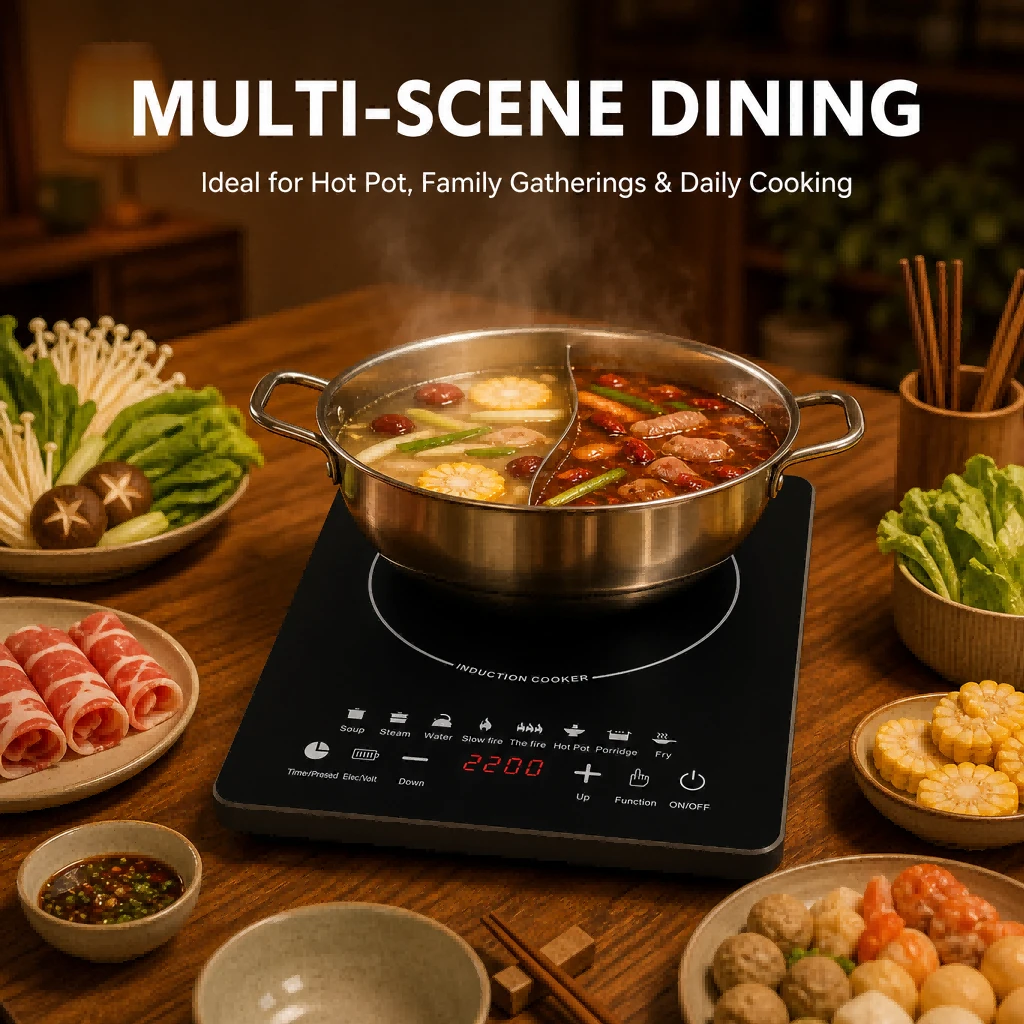
Sourcing an induction cooker involves more than comparing appearance, rated power, and purchase price. For importers and kitchen appliance distributors, the more important questions concern heating performance, cookware compatibility, electrical safety, control accuracy, and long-term product consistency. These factors directly affect customer experience, product returns, and the reputation of the brand selling the appliance.
From a manufacturer's perspective, a well-designed induction cooker requires coordination between the heating coil, electronic control board, cooling structure, glass panel, and external housing. Buyers should understand how these components work together before placing a bulk order.
1. Understand the Heating Technology and Power Performance
The heating system is one of the first areas buyers should evaluate. Unlike conventional electric hotplates, induction cookers generate heat directly in compatible cookware through electromagnetic induction.
An alternating current passes through a coil beneath the cooking surface, producing an alternating magnetic field. This field induces eddy currents in the metal base of the cookware, and electrical resistance converts these currents into heat.
Household induction cookers commonly operate at frequencies of approximately 20–90 kHz. This high-frequency operation allows the appliance to transfer energy to the cookware without first heating a conventional exposed heating element.
When evaluating a supplier, buyers should request the rated voltage, frequency, power consumption, and available heating levels. These specifications help determine whether the appliance matches the electrical supply and cooking expectations of the target market.
Power performance should also be assessed under actual cooking conditions rather than judged only by the number printed on the product label.
2. Check Cookware Compatibility
Cookware compatibility has a direct effect on whether an induction cooker can operate properly. Most conventional induction systems require cookware with a ferromagnetic base, such as cast iron or compatible stainless steel.
Aluminum, copper, glass, and non-magnetic stainless steel cookware generally cannot be used unless they incorporate a suitable magnetic base.
A simple preliminary check is to place a magnet against the bottom of the cookware. If the magnet is attracted, the cookware is more likely to be compatible. However, this test alone does not guarantee satisfactory heating performance.
Manufacturers should also evaluate the cookware's bottom diameter, flatness, material properties, and contact position. An unsuitable pan may cause unstable heating, poor recognition, or inefficient energy transfer.
For importers selling induction cookers together with cookware, compatibility testing should be included in the product development process. This reduces the risk of customer complaints caused by mismatched cooking equipment.
3. Evaluate the Glass Panel Material and Construction
The cooking panel is one of the most frequently used and exposed components of an induction cooker. Its material quality and assembly accuracy influence both appearance and durability.
For a touchscreen induction cooker, buyers should pay attention to several details:
- Surface flatness and dimensional accuracy
- Resistance to normal cooking temperatures
- Scratch and impact resistance
- Printed markings and control-area alignment
- Edge finishing and panel assembly
Tempered glass is commonly used in countertop induction cookers because it provides a smooth cooking surface and is relatively easy to clean.
However, buyers should not evaluate panel quality by appearance alone. During production, manufacturers need to check glass dimensions, edge conditions, surface defects, and the fit between the panel and housing.
A poorly fitted panel may create assembly gaps, uneven pressure, or potential problems during transportation and repeated use.
4. Examine the Touchscreen Control System
The control system determines how users interact with the appliance. For products with touchscreen operation, the sensitivity and consistency of the touch interface are important quality indicators.
Buyers should check whether the control panel responds accurately to normal finger contact, whether the displayed settings are easy to understand, and whether the buttons remain responsive after repeated operation.
From a manufacturing perspective, touchscreen inspection should cover individual control functions, display consistency, response time, and operation under normal working conditions.
It is also important to check whether the control system provides clear feedback when users change heating settings or select different cooking functions.
For overseas brands, control-panel language, icons, and interface layout may need to be adjusted to suit local consumer habits.
5. Check Whether the Cooking Functions Are Practical
Multifunctional cooking capability can help a product serve a wider range of household cooking requirements. However, buyers should distinguish between the number of advertised functions and the actual performance of each function.
Common cooking applications include:
- Stir-frying for everyday meal preparation
- Steaming for vegetables and other ingredients
- Boiling for soups and water
- Water heating for daily kitchen use
- Deep-frying for foods requiring hot oil
Each application places different demands on heating control. For example, boiling requires sufficient heating output, while stir-frying and deep-frying require suitable power adjustment to maintain the desired cooking conditions.
Buyers should ask manufacturers to demonstrate each advertised function using compatible cookware and appropriate operating settings.
A practical product evaluation should include heating response, temperature stability, operating convenience, and whether the selected functions are suitable for the intended market.
6. Review Electrical Safety and Protection Design
Electrical safety should never be treated as a secondary purchasing consideration. An induction cooker combines high-frequency electronic circuits, heating components, and a mains power supply, so its electrical design requires careful evaluation.
Depending on the product design, buyers should check the availability and operation of relevant protection functions, such as:
- Overheating protection
- Overvoltage and overcurrent protection
- Abnormal operating protection
- Pan detection, where equipped
- Electrical insulation and leakage current protection
Not every model includes the same protection configuration. Buyers should request a clear list of actual safety functions rather than assume that all induction cookers offer identical features.
For household cooking appliances, IEC 60335-2-6 is an important international safety standard covering applicable electric cooking appliances, including induction hobs. The relevant national requirements and applicable product category should also be confirmed for each destination market.
Manufacturers should maintain appropriate electrical inspection and safety testing procedures before products are released for shipment.
7. Consider Product Dimensions and Installation Requirements
Product dimensions influence packaging design, storage efficiency, transportation costs, and the available countertop space for end users.
For example, the D62-006 model measures 308 × 84 × 388 mm. This compact rectangular structure is suitable for product ranges targeting consumers who need a countertop cooking appliance without a large built-in installation.
When reviewing dimensions, buyers should also consider the position of the power cord, ventilation openings, control panel, and clearance around the appliance.
Ventilation is particularly important because electronic components generate heat during operation. The internal layout should provide sufficient airflow to help maintain suitable operating temperatures.
During sample evaluation, buyers should check the appliance's stability on a flat countertop and ensure that the external structure does not obstruct normal operation.
8. Evaluate Manufacturing Quality and Factory Inspection
A product sample can demonstrate the design, but consistent mass production determines whether a supplier can support long-term orders.
At the factory level, quality inspection should cover several production stages.
Incoming material inspection checks the specifications and appearance of glass panels, electronic components, plastic housing parts, cables, and other purchased materials.
During assembly, workers and inspectors should check component positioning, wiring connections, fastening conditions, and the fit between the control panel and housing.
Finished-product inspection should include power-on testing, touchscreen operation, heating function checks, appearance inspection, and verification of the product's electrical specifications.
For bulk orders, buyers can also request inspection records and arrange third-party inspection before shipment. The inspection criteria should be agreed upon before mass production begins.
A documented inspection process makes it easier to identify production problems and maintain consistent product quality between different batches.
9. Confirm Voltage, Frequency, Plug, and Market Requirements
Electrical compatibility is especially important when importing appliances for different countries.
Common household electrical supplies include 110–120V systems and 220–240V systems, while supply frequency is commonly 50Hz or 60Hz depending on the market.
These differences affect the electrical configuration of the appliance. Buyers should not assume that changing the plug alone makes a product suitable for another country.
The rated voltage, frequency, power specification, plug type, cable configuration, and applicable certification requirements should all be confirmed before an order is placed.
For private-label projects, packaging information, warning labels, user manuals, and product markings should also be reviewed according to destination-market requirements.
10. Assess the Manufacturer's Customization and Supply Capabilities
A suitable supplier should provide more than a competitive quotation. Buyers also need to understand whether the manufacturer can support product customization, sample development, production scheduling, and repeat orders.
For example, the D62-006 Multifunction Induction Cooker is designed with a tempered glass panel, touchscreen operation, and multiple cooking applications. Its compact dimensions of 308 × 84 × 388 mm make it suitable for countertop kitchen appliance product ranges.
For overseas buyers, customization requirements may include:
- Company logo and product branding
- Housing color and appearance details
- Power plug specifications
- Retail color box and shipping carton
- User manuals and product labels
Before confirming an order, buyers should request a pre-production sample and approve the final specifications, packaging details, and electrical configuration.
The supplier should also provide a clear production schedule, quality inspection arrangements, and shipping terms. These details help both parties establish realistic delivery expectations and reduce misunderstandings during order execution.
Final Thoughts
When sourcing an induction cooker, buyers should evaluate the complete appliance rather than focus on one specification or appearance feature. Heating performance, cookware compatibility, panel construction, touchscreen response, electrical safety, and factory quality control all contribute to the final product's market suitability.
From a manufacturer's perspective, successful cooperation starts with clear technical requirements and a practical sample evaluation process. Buyers who confirm these details before mass production are in a better position to control purchasing risks, maintain product consistency, and develop a stable supply relationship.